Christopher Nolan is standing firmly behind one of the most discussed creative decisions in his upcoming adaptation of The Odyssey: the use of modern English dialogue.
Rather than presenting Homer’s legendary characters through highly formal, theatrical, or historically styled speech, Nolan has chosen language designed to feel immediate, natural, and emotionally recognisable to contemporary audiences.
The decision has already sparked debate among viewers, particularly after early footage revealed characters speaking with mostly modern accents and using familiar expressions. Yet for Nolan, the approach is not an attempt to simplify the ancient epic. It is a way of restoring the emotional force that has allowed the story to survive for centuries.
Language That Connects
Speaking about his creative direction, Nolan explained that he wanted to use “language that has emotional not intellectual meaning to people.”
The filmmaker described his interpretation as “an earthy narrative,” suggesting that the world of The Odyssey should feel physical, human, and lived-in rather than distant or ceremonial.
For Nolan, the choice was ultimately “a no-brainer,” even though he acknowledged that it could attract criticism from audiences expecting a more traditional treatment of the material.
His reasoning reflects a central challenge faced by filmmakers adapting ancient literature. While elevated language can create a sense of historical importance, it can also place emotional distance between the characters and the audience. Nolan appears determined to remove that barrier.
In his version, the heroes of mythology are not untouchable statues from the past. They are fathers, sons, warriors, survivors, and people driven by fear, loyalty, ambition, grief, and hope.
The Moment That Started the Conversation
Much of the public discussion began after trailers and promotional footage offered the first glimpse of the film’s dialogue.
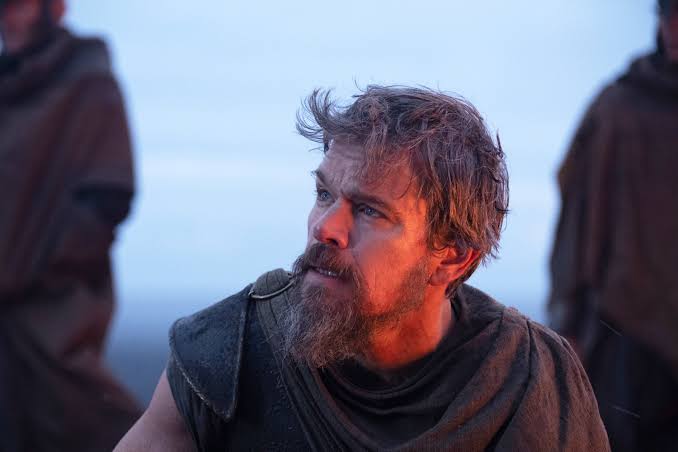
Some viewers were surprised to hear contemporary English and predominantly American accents in a story rooted in ancient Greece. One particular moment attracted attention when Tom Holland’s Telemachus referred to Odysseus as “Dad” rather than using the more formal “Father.”
For critics of the decision, the word felt too modern for the mythological setting. For Nolan, however, that familiarity appears to be precisely the point.
“Dad” carries an emotional intimacy that audiences understand instantly. It transforms Telemachus from a distant literary figure into a young man searching for a missing parent. The language may be contemporary, but the emotional relationship remains timeless.
A Living Myth, Not a Museum Piece
Nolan has framed The Odyssey as a mythic story that should feel alive rather than preserved behind glass.
His interpretation does not appear interested in creating a museum-style recreation of ancient speech. Instead, the film aims to capture the energy, danger, wonder, and humanity of Homer’s epic in a form that speaks directly to modern viewers.
This approach is especially fitting for a story that originally emerged through oral tradition. Long before The Odysseybecame a text studied in classrooms, it was performed, remembered, reshaped, and passed from one generation to another.
Nolan has even compared the epic’s oral storytelling tradition to rap, highlighting the importance of rhythm, performance, and cultural immediacy. The comparison suggests that he is less concerned with preserving exact wording than with recreating the power the story may have held for its earliest audiences.
In that sense, modern English is not necessarily a rejection of Homer. It may be Nolan’s attempt to honour the spirit of a story that was always meant to be heard, felt, and shared.
A Wider Creative Debate
The dialogue is only one part of the growing attention surrounding The Odyssey.
The film has also generated discussion over its casting, costumes, accents, and visual interpretation of mythological figures. Each new glimpse has encouraged debate about how faithfully an ancient epic should be translated for the screen.
Nolan has repeatedly defended his creative choices, arguing that mythology must feel vivid and immediate to retain its power.
His adaptation appears to be guided by emotional truth rather than strict historical reconstruction. The characters may belong to an ancient world, but their struggles remain deeply human. Odysseus longs to return home. Telemachus searches for his father. Families are separated, loyalties are tested, and individuals are forced to confront forces far greater than themselves.
These themes do not require archaic language to remain meaningful.
Bringing Homer Into the Present
Nolan’s defence of modern English reveals a filmmaker focused on connection rather than convention.
By choosing accessible dialogue, he is inviting audiences to experience The Odyssey not simply as a celebrated piece of ancient literature, but as a living story filled with emotional urgency.
The decision may continue to divide viewers, especially those hoping for a more classical interpretation. Yet Nolan has never been known for approaching ambitious material cautiously.
His version of The Odyssey appears designed to make audiences feel the myth before they analyse it.
For Nolan, the language of the ancient world does not need to sound ancient. It needs to sound human.