




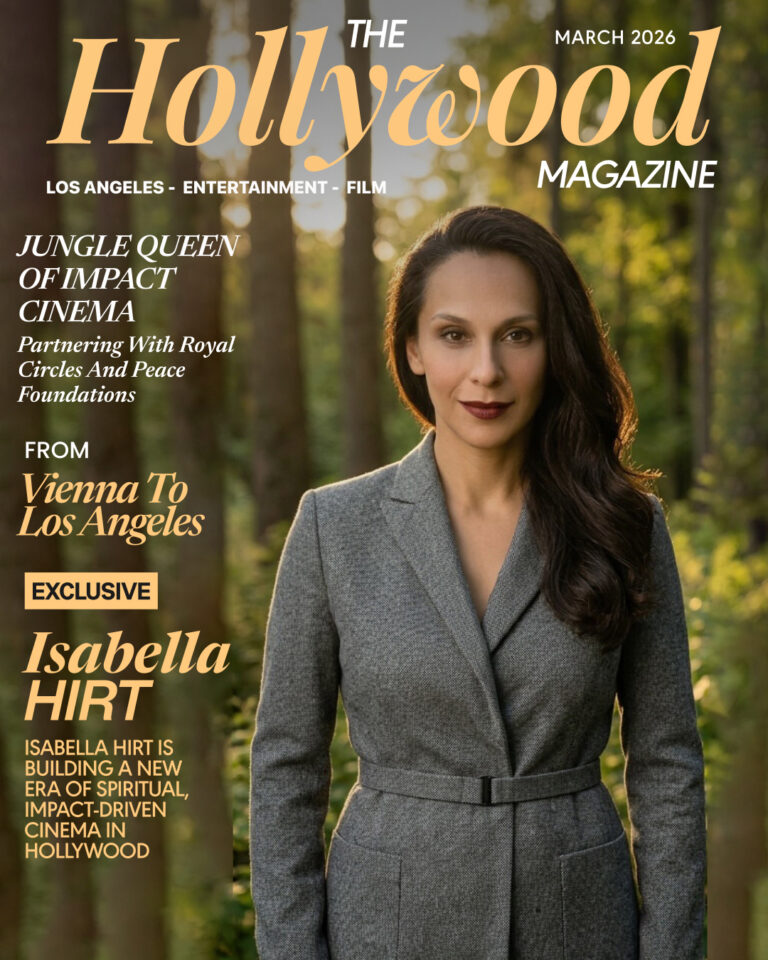
“Hollywood isn’t dead, but its conscience is,” says impact-driven producer Isabella Hirt. While much of the industry chases clicks, influencer fame and algorithm-driven celebrity, she is quietly building something far more ambitious and necessary: a slate of royal and spiritual films that confront obsession, power and responsibility in a post-Epstein world — and that dare to bring beauty and ethics back to cinema.
From Vienna, Hirt — founder of HirtProductions and HirtAgency — moves easily between worlds. One moment she is discussing investor structures and family-office risk profiles; the next she is speaking about palaces, saints and the cinematic legacy of Stanley Kubrick. As a producer closely connected with European royal circles and cultural institutions, she operates naturally between film markets, imperial ballrooms and global strategy meetings.
Her credibility is anchored not only in storytelling but also in service. Hirt is a representative of the Flame of Peace, a humanitarian initiative promoting reconciliation, and a recipient of the Order of Saint Elizabeth. These distinctions reflect a brand built not merely on glamour, but on diplomacy, charity and responsibility.
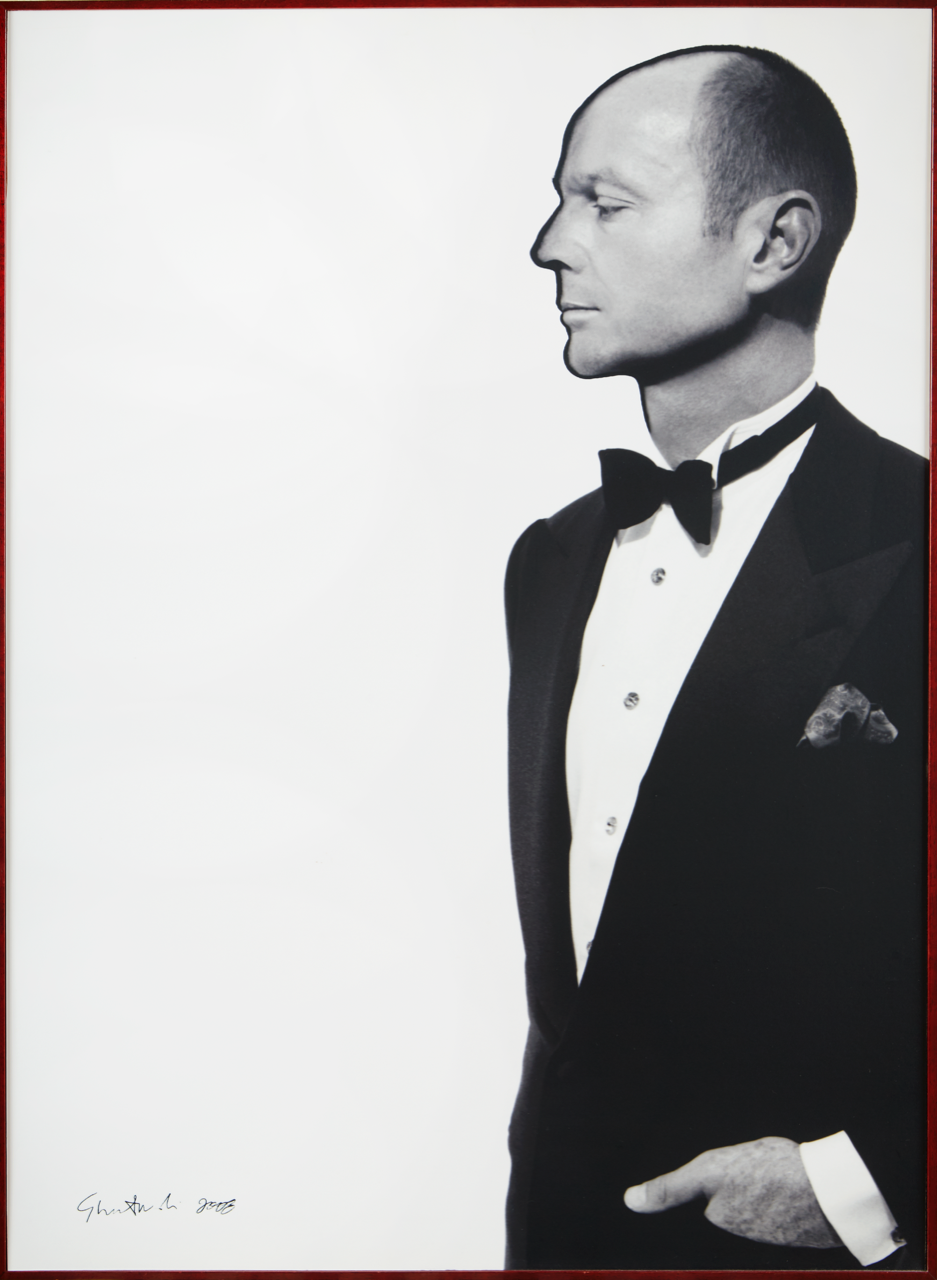
Among her closest creative collaborators is Prince Dimitri, the New York–based jewelry designer and member of a historic royal house. Known internationally for his heritage-inspired designs and his book Once Upon a Diamond, Prince Dimitri contributes a luxury aesthetic and historical depth to Hirt’s cinematic universe.
Kubrick’s Waterloo: A Film About Obsession
At the center of Hirt’s current slate is Kubrick’s Waterloo, a character-driven film exploring the obsession of filmmaking itself, set against the shadow of Napoléon.
“It’s the story of a director who wants to make the greatest historical epic ever shot about Napoléon,” Hirt explains. “He’s brilliant, visionary — and increasingly trapped in his own perfectionism.”
Rather than recreating battlefields alone, the film examines the hidden trenches behind the camera: sleepless nights, fractured relationships and the psychological cost of artistic obsession.
“The question the film asks is simple,” she says. “When does genius become a private Waterloo — a self-inflicted disaster that takes everyone around you down with it?”

Royal Stories With Modern Meaning
Hirt’s wider slate continues that exploration of power and responsibility across centuries.
One project tells the story of Emperor Karl I and Empress Zita, leaders who attempted to pursue peace during one of Europe’s most violent periods. Another project, The Legacy of the House of Savoy, explores the enduring mystery and spiritual significance surrounding the Shroud of Turin.
A separate film examines the creative relationship between Marilyn Monroe and Billy Wilder, offering a more intimate look at artistic brilliance and vulnerability.
Each project blends glamour, history and faith, but always circles back to the question that defines Hirt’s philosophy:
“What does power look like when it’s actually used for good — and what happens when it isn’t?”
Hollywood After Epstein
If Hirt’s projects feel different from much of today’s entertainment culture, that is intentional.
She observes the influencer economy with the analytical eye of a producer rather than a celebrity.
“We’ve built an entire system around shameless self-exposure,” she says. “Stars undress in fifteen-second clips and call it brand strategy. It can make fast money — but from an investor’s perspective, it’s a bet on hype, not fundamentals.”
For Hirt, the current boom in lingerie brands and performative intimacy online signals a deeper exhaustion.

“When attention requires selling more and more skin, it usually means you’ve run out of story.”
The post-Epstein revelations have only reinforced her position.
“The documents were an X-ray of how broken parts of the old elite system really were,” she says. “If Hollywood treats that as a temporary scandal rather than a turning point, we’ve learned nothing.”
Her proposed solution is structural reform.
“Studios already perform due diligence on money. Why not perform due diligence on character? Ethics clauses and background checks should become standard.”
Cinema as an Ecosystem
Unlike many filmmakers, Hirt speaks the language of finance as comfortably as the language of art.
Before becoming an award-winning producer and the lead agent behind HirtAgency, she worked in European media and public broadcasting, developing expertise in international co-productions and distribution strategies.
Today she positions HirtProductions as an investment-ready slate company built around multiple revenue streams: films, series, documentaries, luxury collaborations and cultural events.

“Real intellectual property does not evaporate overnight,” she says. “Serious investors want assets with longevity.”
Her collaboration with Prince Dimitri extends this philosophy into luxury design. Together they are developing jewelry concepts tied to the historical worlds of their films — pieces that appear on screen, on red carpets and in collectors’ cases.
“A jewel can carry history, faith and irony all at once,” Hirt says. “Our audience can literally wear part of the story.”
Cinema, Diplomacy and Peace
Hirt’s role as a representative of the Flame of Peace and her investiture into the Order of Saint Elizabeth place her work within networks where cultural diplomacy and humanitarian initiatives are central.
“If I say I’m making spiritual and royal cinema,” she says, “I must live those values in real life — in how I treat crews, how contracts are written and how stories are told.”
Her ambitions extend beyond film premieres.
“In the coming years I want to speak about peace everywhere I go — from festival stages to royal ballrooms and one day at the United Nations,” she says. “The red carpet and the diplomatic floor are not separate. They are two sides of the same mission.”

Recognition and Momentum
That vision has already begun to attract international recognition.
At the Go Global Awards, Hirt was honored as a Film Visionary, selected from more than 6,000 companies worldwide.
For her, the recognition confirms that a different kind of glamour — one rooted in values and cultural dialogue — has economic potential.
“Stories that build bridges between continents and faith traditions are not a niche,” she says. “They are the next growth story.”
The Jungle Queen Philosophy
Hirt’s creative identity, sometimes described as the “Jungle Queen”, reflects a belief that cinema must move beyond content and become a living cultural ecosystem.
Films, in her vision, connect with museums, fashion, philanthropy and global conversations.
“I don’t think in content,” she says. “I think in ecosystems. Films are the beating heart — but stories must breathe in galleries, discussions, education and design.”

A Hollywood Reckoning
What makes Isabella Hirt such a compelling figure in Hollywood today is her timing.
She is building a cinema of conscience precisely when the industry’s lack of one is under scrutiny. She is creating films about obsession at a moment when audiences are exhausted by celebrity self-obsession. And she is betting that the future belongs not to unchecked power, but to responsible storytelling.
“If I could say one thing to Hollywood,” she says, “it would be this: stop undressing and start pulling yourselves together. Less stunt, more story. Less personality cult, more character.”
Her goal is both bold and simple.
“I want people to say the Jungle Queen from Austria didn’t just make films — she built bridges between continents, cultures and people.”
Awards, billboards and royal collaborations are milestones, she says, but not the destination.
“In a post-Epstein era, the real prestige is this: did your stories heal anything? Did they protect anyone? Did they give people courage?”
“That,” Isabella Hirt says, “is the cinema I want to stand for.”